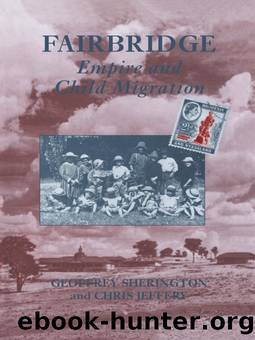
Fairbridge: Empire and Child Migration by Chris Jeffery Geoffrey Sherington
Author:Chris Jeffery, Geoffrey Sherington [Chris Jeffery, Geoffrey Sherington]
Language: eng
Format: epub
Tags: History, General
ISBN: 9781136224867
Google: 9Ue0AAAAQBAJ
Publisher: Routledge
Published: 2013-09-05T01:18:29+00:00
Source: CES, Fairbridge Farms, Report for 1932.
She said, âWell what is your trouble?' and of course I suppose being from Fairbridge and having stood up for myself, I spoke out, and asked if we could have this extension of time. Immediately the teacher accused me of upsetting the staff, and, once again, it was because I came from Fairbridge. You see, she wouldnât pick on any of the others in the same way. So I feel that there was always that little point there, that they would rub it into us when they could.62
The placing of Fairbridge children into jobs was accompanied by a system of after-care which began under Kingsley Fairbridge but was developed further in the 1920s and 1930s. In late 1923 Fairbridge had recognised that the expansion of the farm would inevitably lead to a more formal system of after-care. With the large numbers involved no longer could he send out boys and girls to employers whom he knew personally. The London executive passed a resolution in February 1924 that boys and girls out in work could always regard Pinjarra as home while Barnardoâs asked that for the first two years of employment each child be visited not less than twice a year.63 The disputes of the years following the death of Kingsley Fairbridge interrupted some of the plans for a system of after-care, but in 1928, Miss Mary Dennehy, who had joined the farm in 1916, became the first after-care officer. In the first year she and her companion Miss Ogilvie-Forbes travelled 6,000 miles by car throughout Western Australia. Most of the jobs was in the south-west dairy districts but employment was also found, for the boys at least, on wheat farms and cattle and sheep stations in the far north-west.64 Miss Dennehy worked as after-care officer for almost eight years, keeping in touch with many boys and girls who would remember her with affection, before ill health forced her retirement.
The record-keeping system of after-care followed the model already established for school reports which were compiled while children were still at the farm. Regular reports on Fairbridge children were forwarded to the Society in London. The reports were usually very detailed and included in the outline of the general aspect of living and working conditions of the young employees were comments on church attendance, the savings accounts and membership of the Old Fairbridgians Association. The conditions laid down for employers were quite strict, requiring them to terminate employment only after contacting Pinjarra with sufficient notice. There was provision for paid holidays. On the other hand, the young employees had to pay for their clothing out of their wages and employers were asked to supervise their employeeâs conduct.65 On a number of occasions the farm principal removed children from employers who were not seen as suitable. Equally, he had to find a new job for the young employees if their employers found them unsatisfactory. Many Fairbridge children had a number of jobs in the first few years after leaving the farm.
Download
This site does not store any files on its server. We only index and link to content provided by other sites. Please contact the content providers to delete copyright contents if any and email us, we'll remove relevant links or contents immediately.
Spell It Out by David Crystal(36108)
Life for Me Ain't Been No Crystal Stair by Susan Sheehan(35795)
Cecilia; Or, Memoirs of an Heiress — Volume 1 by Fanny Burney(32538)
Cecilia; Or, Memoirs of an Heiress — Volume 2 by Fanny Burney(31934)
Cecilia; Or, Memoirs of an Heiress — Volume 3 by Fanny Burney(31925)
The Great Music City by Andrea Baker(31911)
Professional Troublemaker by Luvvie Ajayi Jones(29644)
We're Going to Need More Wine by Gabrielle Union(19030)
The Secret History by Donna Tartt(19025)
Twilight of the Idols With the Antichrist and Ecce Homo by Friedrich Nietzsche(18617)
All the Missing Girls by Megan Miranda(15922)
Cat's cradle by Kurt Vonnegut(15324)
Pimp by Iceberg Slim(14476)
Bombshells: Glamour Girls of a Lifetime by Sullivan Steve(14046)
For the Love of Europe by Rick Steves(13855)
Talking to Strangers by Malcolm Gladwell(13340)
Norse Mythology by Gaiman Neil(13332)
Fifty Shades Freed by E L James(13228)
The Social Justice Warrior Handbook by Lisa De Pasquale(12182)
